
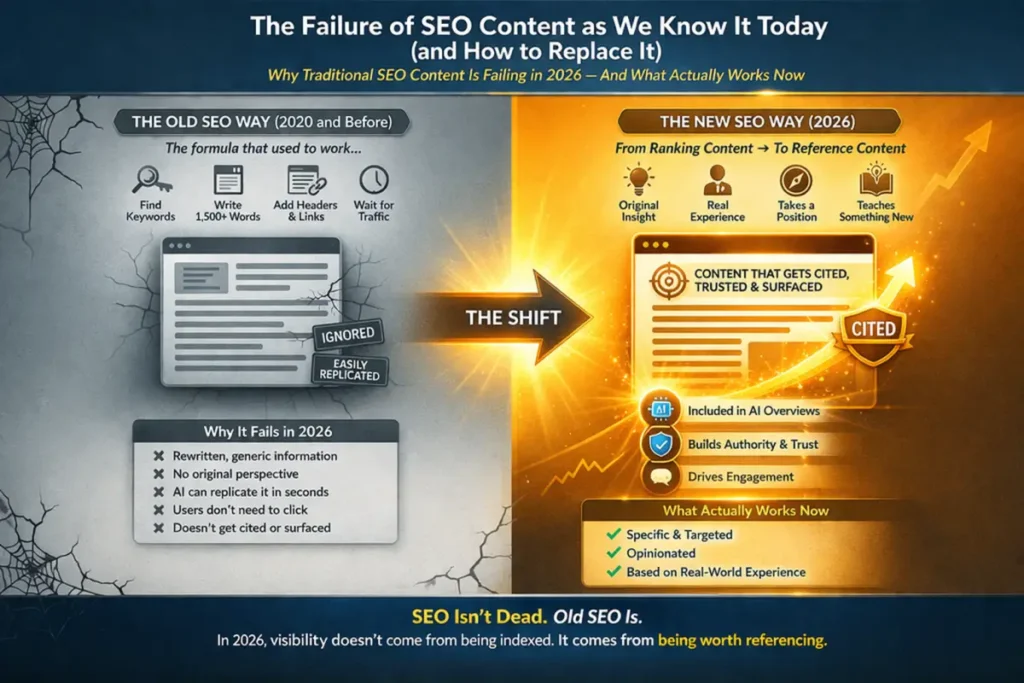
The strategy of creating an SEO content piece has been very consistent over time. Identify some keywords. Write an article of at least 1500 words. Use header tags to organize your content. Add links to other relevant pages on your website. Wait for visitors. That model had success – until it did not. In 2026, the vast majority of SEO content fails due to the structure upon which it was based and the disappearance of that system.
The Root Cause of This Problem: Search Behavior Has Changed
Search behavior is not simply about ranking. It’s about providing answers. People do not click on ten blue links as they once did. Instead, they receive summary information about their query from artificial intelligence driven search products. Examples include the use of AI generated search results by Google and similar tools such as Chat GPT. The ultimate objective of each of these solutions is the same — provide the user the correct answer quickly.
Which means:
- If your content does not directly address an aspect of the users’ question, then it will likely not be viewed.
- And that is true for virtually all traditional forms of SEO content.
Why Traditional SEO Content Will Continue to Fail
Most SEO articles today follow a nearly identical format:
- Rewriting prior published content
- Providing surface level information
- Optimized for keyword inclusion rather than insight
- Creates a problem known as “saturation.”
There are literally tens of thousands of articles addressing the exact same topics using virtually identical formats, including no unique perspectives. Artificial Intelligence can easily replicate this within seconds. Search Engines are aware of this reality. So are users.
Therefore, the content is essentially ignored; not because it is poor quality; but because it is easily replicatable.
The Paradigm Shift: From Creating Rankable Content to Creating Referenced Content
What replaces traditional types of SEO content is not additional optimization techniques. Rather, it is a totally different form of content.
Content that provides:
- Original insights
- Reflects actual personal experiences
- Takes a position
- Teaches the reader something new
This is how the type of content that receives citation, becomes trusted and ultimately surfaces within searches.
Rather than optimizing for ranks, writers need to optimize for references. Therefore, you must produce content that addresses the users’ questions better than any other source available — both more comprehensively and more meaningfully.
Authority Driven Content Strategies Are Increasingly Important
Search engines are increasingly relying on signals related to credibility and experience in determining relevance and authority. Not only what is being stated — but also who is stating it and why it should matter.
This is where many SEO strategies fail.
They focus on producing large volumes of content rather than unique perspectives.
Production vs. Substance. Coverage vs. Contribution.
However, authority is not created via volume — authority is established through clarity, consistency and insight.
What Performs Well Today
Content that is successful in 2026 differs dramatically:
- It is targeted
- It expresses opinions
- It reflects actual knowledge based upon real world experiences
As opposed to publishing articles that ask “what is x”, successful authors ask questions such as:
- Why does x currently matter?
- What are individuals getting wrong when considering x?
- What really works in practice regarding x?
This is the kind of content that:
- Gets incorporated into artificially generated AI answers
- Builds trust with readers
- Generates significant interaction and engagement
The Bottom Line
SEO has not died — however, the older version of it has.
Publishing optimized content weekly may continue to yield decreasing returns. Alternatively, you could adjust your strategy so that you produce content that earns consideration.
Visibility in 2026 does not occur from being indexed. Visibility occurs from having worthiness to reference.